Why Use Glass Yarn For Optical Cables?
Choosing the right reinforcement can determine whether an optical cable survives installation and years of service. Glass Yarn For Optical Cables offers a practical balance between strength, weight, and electrical safety. Its fine glass fibers help resist pulling forces during cable deployment. They also maintain a dielectric structure around sensitive optical fibers.
In field installations, cable teams often value glass yarn because it adds tensile support without conducting electricity. This feature matters near power equipment, railway systems, and communication infrastructure. The material can also improve resistance to heat, moisture, and some mechanical stresses. However, performance depends on yarn construction, coating quality, cable design, and manufacturing consistency.
A small detail matters.
Glass yarn is not a universal solution. It may not replace steel armor where severe crushing, impact, or rodent protection is required. Engineers should review tensile ratings, elongation, flame performance, bending limits, and applicable industry standards. Laboratory testing remains important, especially when cables enter ducts, buildings, or harsh outdoor environments.
Reliable manufacturers normally provide technical data, batch controls, and test evidence. Installers should also examine how the yarn behaves during stripping and termination. Loose strands can irritate skin and complicate preparation. Better handling procedures reduce that risk.
The most useful choice is not always the strongest material. It is the material matched to the route, environment, and installation method. Glass yarn can support durable optical networks, but careful specification still matters. Mistakes happen when performance claims replace measured design decisions.
What Is Glass Yarn in Optical Cables?
What Is Glass Yarn in Optical Cables?
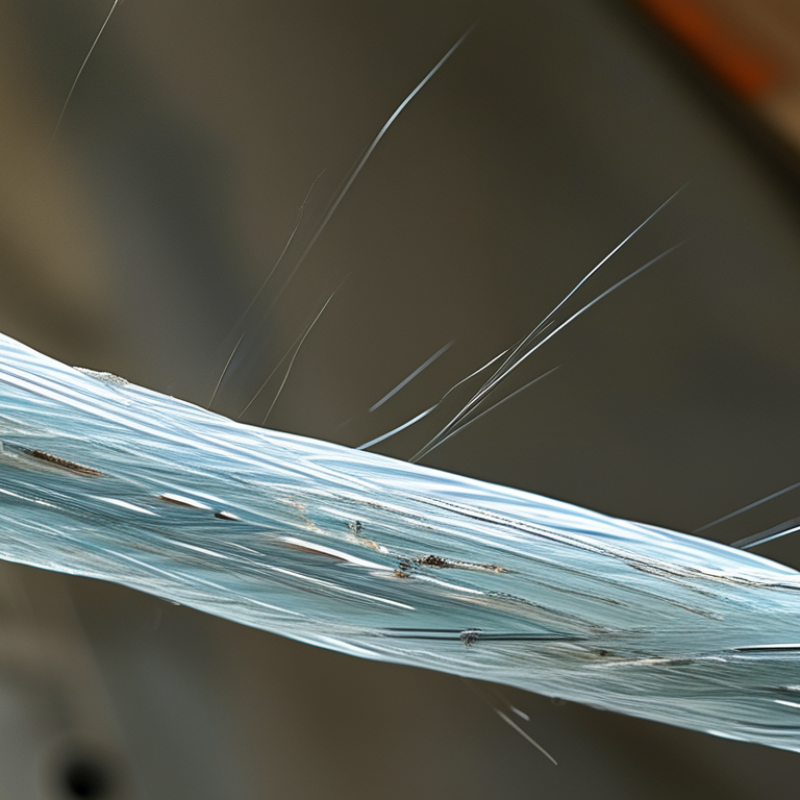
Glass yarn is a bundle of continuous glass filaments placed around optical fibers or loose tubes. It is not the fiber core that carries light. Instead, it works as a lightweight strength member inside the cable.
The yarn spreads pulling forces during installation and helps limit deformation when the cable bends, twists, or faces crushing pressure.
It is usually made from E-glass and may receive a coating for handling and moisture resistance. Its non-conductive structure suits power-adjacent routes and reduces grounding concerns.
It can also discourage rodent damage, although this protection is not absolute.
Small detail. Yarn performance depends on filament count, linear density, twist, and placement. A loose design may shift under tension, while excessive packing can reduce flexibility.
IEC 60794 testing covers cable tensile, crush, impact, and environmental performance, but test results still depend on the complete cable structure.
The OECD Broadband Portal reported that fiber represented about 42% of fixed broadband subscriptions across OECD economies in 2023.
The ITU Global Connectivity Report 2022 also estimated that 2.7 billion people remained offline. These figures reflect continued pressure for larger, tougher fiber networks, where simple reinforcement choices matter.
Field experience suggests glass yarn is useful, but it should not replace careful cable routing and verified mechanical testing.
How Glass Yarn Supports Cable Structure and Protection
Why Use Glass Yarn For Optical Cables?
How Glass Yarn Supports Cable Structure and Protection
Optical networks are expanding rapidly. The OECD Broadband Statistics report recorded fiber connections at 42.7% of fixed broadband subscriptions in December 2023. More fiber routes also mean greater exposure to pulling, bending, crushing, and moisture during installation. Glass yarn gives the cable a strong, lightweight tensile layer around delicate fiber tubes. It helps distribute pulling force instead of transferring stress directly to the fibers.
The material is nonmetallic and electrically insulating. That feature suits cables installed near power infrastructure. Glass yarn can also improve resistance against crushing and rodent damage when combined with a suitable sheath. In practical work, installers often notice its value when a cable passes through crowded ducts or narrow handholes. Small details matter. The yarn keeps the cable stable while limiting unnecessary weight.
Cable performance still depends on the complete design. Glass yarn cannot repair poor jacketing, excessive bending, or careless handling. It is easy to overstate this benefit. Test methods under IEC 60794 evaluate optical cable tensile, compression, and environmental performance, but field conditions remain less predictable. The ITU Facts and Figures 2023 report estimated 5.4 billion people were online, increasing pressure for dependable access networks. For this reason, engineers should match yarn quantity, lay length, and sheath design to the installation route, rather than treating reinforcement as a universal solution.
Why Glass Yarn Resists Moisture, Heat, and Corrosion
Why Use Glass Yarn For Optical Cables?
Why Glass Yarn Resists Moisture, Heat, and Corrosion
Glass yarn protects optical cables without adding heavy metal strength members. Its silica-based fibers do not rust, absorb little moisture, or support corrosion. Typical E-glass yarn specifications report tensile strengths above 1 GPa, although results vary with coating and construction. That strength helps prevent fiber movement when cables face pulling, bending, or vibration.
The material also performs well during environmental aging. Telcordia GR-20-CORE commonly evaluates cable designs at 85°C and 85% relative humidity for 30 days. IEC 60794-1-2 adds temperature cycling, water penetration, and mechanical test methods. These conditions expose weak designs quickly. Still, glass yarn is not a complete moisture barrier. Cable jackets, gels, binders, and yarn sizing can change performance. That detail is often overlooked.
Tips: Check the yarn’s tensile data, coating type, and water-blocking design together. Ask for test records, not only catalog claims. For coastal routes, inspect metallic parts separately. Glass will not rust, but nearby metals still can. Field installation also matters; crushed yarn loses strength. A small mistake there becomes expensive later.
Which Optical Cable Designs Use Glass Yarn?
Glass yarn is used in optical cable designs that need dielectric strength, light weight, and resistance to moisture. It contains many fine glass fibers, usually arranged around the fiber core. Unlike metallic strength members, it does not conduct electricity. This makes it suitable near power equipment and in areas vulnerable to electromagnetic interference.
Loose-tube cables commonly use glass yarn around the tubes. The yarn helps control pulling forces during installation and supports the jacket against crushing. Outdoor distribution cables may also use it beneath the outer sheath. In some designs, glass yarn adds rodent resistance, although its performance depends on yarn density and jacket construction. It is not a complete solution by itself.
Indoor tight-buffered cables can use glass yarn when installers need flexible, flame-conscious, and nonconductive protection. Ribbon cables and compact microduct cables may also include it, especially where space is limited. The exact layer matters. A poorly positioned yarn can create uneven pressure or make stripping difficult. That detail is easy to overlook.
Tips: Match the yarn structure to the cable’s pulling load. Check bending performance, crush resistance, and temperature limits together. Ask for verified test data, not only a material description. In real installations, handling conditions can expose weaknesses that laboratory figures miss. Review the design after installation.